What even is the Fractional Fourier Transform?
The classical Fourier Transform (FT) maps a signal from the time domain to the frequency domain. If one thinks of time and frequency as coordinates on a common plane, the FT can be regarded as a rotation by $\pi/2$ radians. Applying the FT a second time yields a reflected version of the input (the frequency domain maps back to reversed time), a third application maps inverted time to inverted frequency, and a fourth returns to the original time domain. Sequential applications of the FT therefore correspond to rotations by multiples of $\pi/2$ in the time–frequency plane.
The Fractional Fourier Transform (FRFT) generalizes this idea by introducing a continuous order parameter $\alpha \in \mathbb{R}$ that interpolates between time and frequency representations. The FRFT of order $\alpha$ corresponds to a rotation by $\alpha\pi/2$ radians, giving rise to what we call the $\alpha$-domain—an intermediate representation that blends characteristics of both time and frequency.
A key challenge for sonic applications is that signals in the $\alpha$-domain are generally complex-valued. To address this, we introduce the Real Fractional Fourier Transform (RFRFT), which extracts the real part of the FRFT. The RFRFT preserves linearity and introduces a double rotation property: for real signals, taking the real part reduces the intensity of the original rotation while adding an equally significant rotation in the opposite direction. This double rotation is the source of many of the distinctive sonic behaviors observed throughout our work.
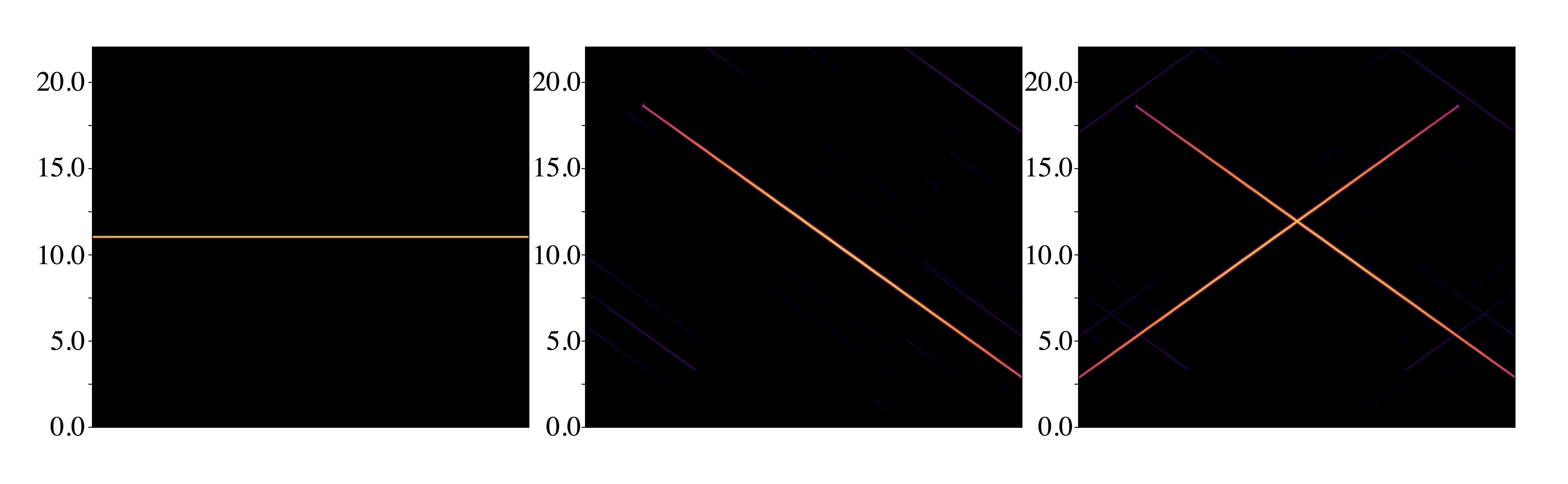
Figure 1. From left to right, spectrograms of a sinusoid at 11,025 Hz, its FRFT, and its RFRFT, both of order $\alpha = 0.25$. Frequency axis is measured in kHz while time axis in seconds. While the FRFT rotates the signal in the time–frequency plane, the RFRFT introduces a second rotation in the opposite direction.
Fractional Fourier Transform Synthesis and Processing
By interpreting the FRFT as a rotation in the time–frequency plane, we introduce several techniques for real-time sound synthesis and processing in the α-domain. Each method exploits different aspects of the FRFT's geometric and algebraic properties to produce sonic behaviors that are fundamentally different from their conventional Fourier-based counterparts.
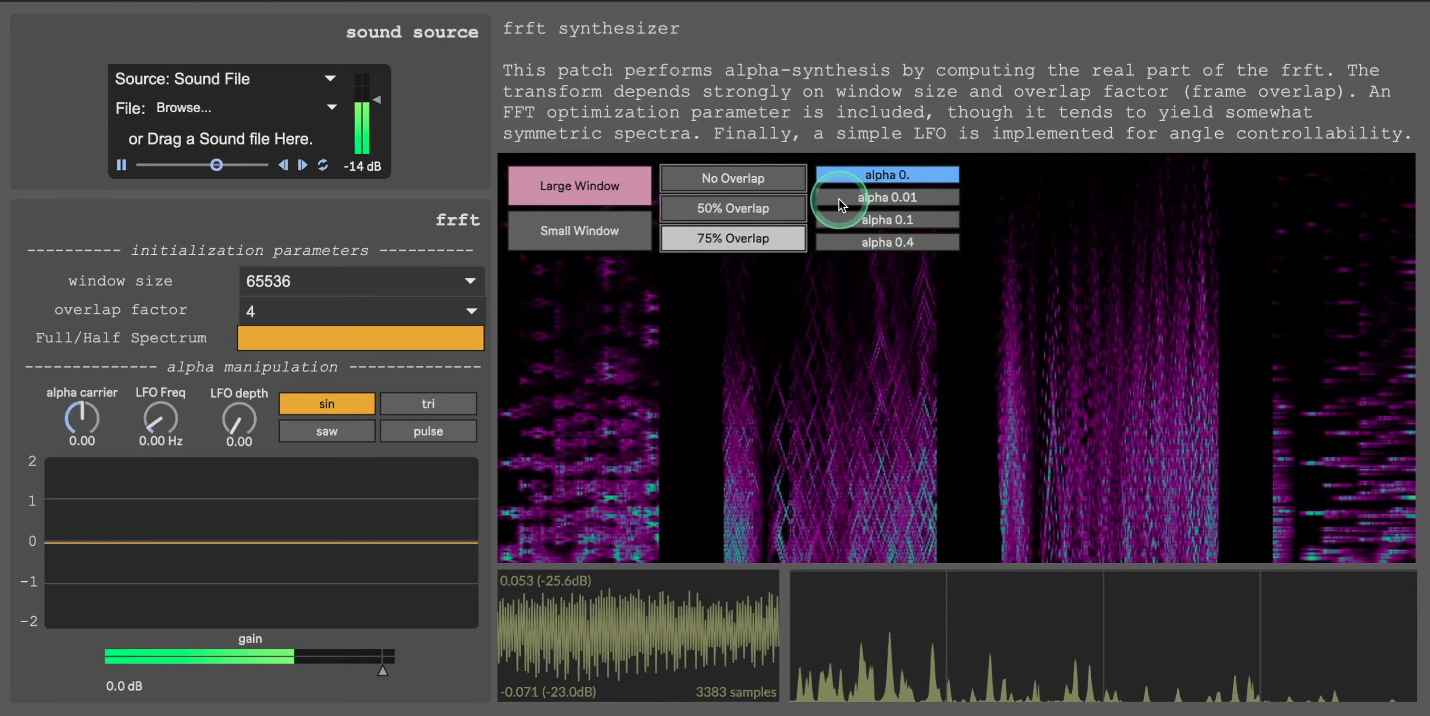
Figure 2. frft package. Max patcher using the frft~ external for real-time FRFT-based sound synthesis and processing.
Methods
α-synthesis and α-processing apply the RFRFT frame-by-frame with overlap-and-add reconstruction. For harmonic signals, the double rotation property transforms each partial into a pair of chirp-like components, yielding dynamically evolving textures. The order α controls the rotation strength, the window length shapes the chirp slope, and the hop size can introduce emergent rhythmic patterns.
α-convolution and α-filters extend the classical convolution theorem to the α-domain: two signals are multiplied in the α-domain and transformed back to time. Since each α-domain subband corresponds to a chirp spanning a range of frequencies, filtering in this domain produces perceptually rich timbral colorations—from metallic distortion with short windows to rhythmic amplitude modulation with longer ones.
α-ring modulation multiplies the FRFTs of two signals and extracts the real part. The FRFT of a sinusoid is a complex chirp, so multiplying two such chirps yields a new chirp whose instantaneous frequency is the sum of the originals—a form of frequency modulation where the modulator is itself a chirp. Oppositely directed chirps produce interference patterns heard as rhythmic structures.
References
- Gutiérrez, E., Haki, B., Sing Long, C., Font, F., Serra, X., & Cádiz, R. F. (2026). Real-time fractional Fourier sound synthesis and processing. Journal of the Audio Engineering Society.
- Gutiérrez, E., Cádiz, R. F., Sing Long, C. A., Font, F., & Serra, X. (2025). Fractional Fourier Transform sound synthesis. In Proceedings of the International Computer Music Conference, Boston, USA.