

Music Technology Group, Universitat Pompeu Fabra, Barcelona
Abstract: As generative audio models grow in complexity, the computational and ecological costs of synthesizing everyday sounds have become increasingly prohibitive, often requiring industrial-scale resources and massive datasets. In this paper, we present SCAPES: a Semantically Conditioned Autoregressive Prior for Environmental Sounds. SCAPES is a lightweight, resource-efficient generative model designed to synthesize high-fidelity environmental textures through high-level semantic control. By operating on the continuous latent manifold of a neural audio codec, our approach bypasses the rigid structural constraints inherent to discrete tokenization. We propose a segmentation strategy that decomposes audio into overlapping segments, enabling a Continuous Normalizing Flow (CNF) to model the evolution of latent trajectories using Flow Matching. Our experiments demonstrate that a 36-million parameter instance of SCAPES can be trained on limited, uncurated datasets using a single consumer-grade GPU. Notably, training convergence is achieved in a duration similar to double the lenght of the source audio itself, yielding high-fidelity results that maintain robust long-term stability and semantic adherence. Furthermore, we showcase the model's capacity for smooth semantic interpolation, providing a flexible and accessible tool for open research and creative sound design.
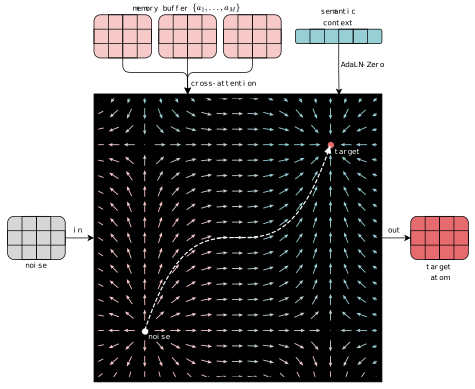
SCAPES (Semantically Conditioned Autoregressive Prior for Environmental Sounds) is a generative audio framework for high-fidelity environmental texture synthesis with semantic control. It operates on the continuous latent manifold of a neural audio codec, using a Transformer-based Continuous Normalizing Flow trained via Flow Matching. A CLAP semantic embedding conditions generation at fine temporal resolution, enabling intuitive control over the output.
Explore SCAPES across three tasks: resynthesis, semantic generation, and interpolation. Select a sound class using the emoji buttons below to hear the original alongside the model's output.
The model reconstructs the input sound from its CLAP embedding and uses ground-truth past context at each generation step.
The model generates a new sound from scratch, conditioned only on the CLAP embedding from the input sounds. Generation is fully autoregressive.
The model smoothly transitions between two sound classes through fully autoregressive modeling conditioned on the interpolation between their CLAP embeddings. Select a source and a target class.
This work has been supported by the project "IA y Música: Cátedra en Inteligencia Artificial y Música (TSI-100929-2023-1)", funded by the "Secretaría de Estado de Digitalización e Inteligencia Artificial and the Unión Europea-Next Generation EU". Additionally, we would like to express our sincere gratitude to Daniela Quimis, Clara Charbonnier, Jan Pol Obrador, Marcel Manzano, Omar Hamze, Jordi Fabregat, Eduard Herrera, and Eric Mas, for their valuable insights into extending the model to diverse audio sources, exploring alternative training techniques, and helping shape the design of an intuitive demonstration of SCAPES.
